
Food Processing Facility Roofing roof planning built from the roof condition.
The roof path may involve leak repair, preventive maintenance, coating review, recover planning, or full replacement depending on the age and condition of the assembly.
Commercial Roofing Contractors of Boston helps organize those choices into clear next steps for commercial buildings in Boston, MA.
Food Processing Roofing in the Boston Region
Boston has a deep, working food economy that runs well beyond its restaurants. The New England Produce Center and the Boston Market Terminal in Chelsea move enormous volumes of fresh product daily, the seafood houses on the Boston Fish Pier and around the Marine Industrial Park process catch year-round, and bakeries, commissaries, dairy handlers, and specialty manufacturers fill the industrial blocks of Everett, Chelsea, and the Newmarket district off Massachusetts Avenue. We roof these production buildings, and they behave nothing like a warehouse or an office park even when they sit on the same street.
What sets a processing plant apart is that the roof is part of a food-safety envelope. A leak over an active line is not a maintenance ticket, it is a potential contamination event that triggers the plant's quality-assurance team, possible product holds, and regulatory documentation. We plan these scopes to remove that risk before it happens rather than respond to it afterward, which shapes the materials we use, how we sequence the work, and how we handle the building's interior moisture and refrigeration loads.
Processing floors are cleaned aggressively and often. High-pressure hot-water and chemical washdown at the end of each shift fills the building with warm, saturated air that rises straight into the deck. Over a refrigerated or climate-held space, that interior moisture meets a cold underside and condenses inside the assembly, corroding steel deck and soaking insulation with no exterior leak to warn anyone. So we look at the building as a vapor system, not just a top surface. Getting the vapor retarder and assembly right for a washdown environment is what keeps a processing roof from rotting from the inside.
Refrigeration Loads and the Cold Chain
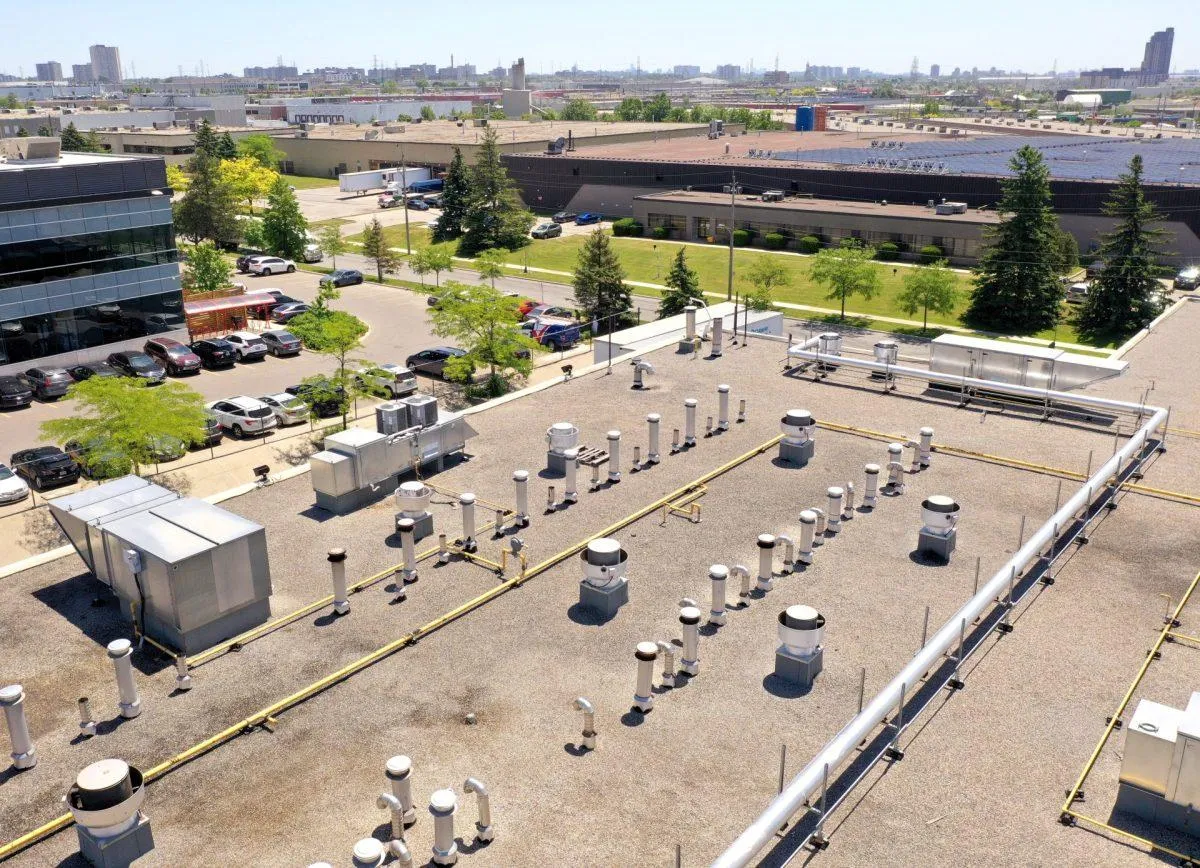
Freezer rooms, chill rooms, and blast-freezing areas raise the stakes further. The roof assembly above refrigerated space has to maintain thermal continuity so the cold chain holds and condensation does not form within the assembly. Tapered insulation over these areas has to be designed around the actual operating temperatures and the direction of vapor drive for the New England climate. On top of that, refrigeration brings heavy rooftop equipment — condensers, compressor racks, and the structural and vibration loads that come with them.
- Tapered insulation designed for the specific freezer or chill-room temperatures rather than a generic flat-roof package.
- Drainage designed to keep water off refrigerated bays, because ponding adds thermal load to the refrigeration system and accelerates deck corrosion.
- Curb, support, and vibration detailing matched to the condensers and racks the refrigeration system actually carries.
- Vapor control coordinated to the cold-side conditions so moisture is not driven into the assembly.
Snow Load Over Refrigerated Space
New England winters compound the refrigeration problem. Snow accumulates and lingers longer on a cold roof above a freezer than it does on a warmer building, because there is little heat loss from below to help it melt off. That standing snow and the meltwater behind ice dams add load and create ponding exactly where the assembly can least afford it, over the coldest, most condensation-prone bays. We design drainage and, where needed, snow-clearing access around the refrigerated areas specifically, and we size tapered insulation so meltwater moves to drains rather than pooling and refreezing. Freeze-thaw cycling and Nor'easter uplift also test seams and flashings on a processing roof harder than on a mild-climate building, so the attachment and detailing have to account for the local weather, not just the interior conditions.
Compliant Materials Above Production
Not every roofing product belongs over a food-contact zone. USDA- and FDA-regulated plants require membranes, adhesives, primers, and sealants that are confirmed acceptable for the production environment, and that is not a universal standard across every manufacturer or product line. White single-ply membranes are generally workable over enclosed processing areas, but the specific formulation and the flashing chemistry have to clear the plant's food-safety plan. Many ordinary roofing adhesives carry solvents that are not acceptable in a food environment, so we confirm material acceptability with the plant's QA team before anything is specified over a production line.
Sequencing Around Production and Sanitation
Boston-area plants frequently run two or three shifts with a single weekly sanitation window as the only time the floor is down. Any work that opens the envelope above an active line has to fit inside that window, with the production team and QA manager confirming the floor is clean and protected before we start. We build the phasing plan around the production calendar, dry in each section before the line comes back, and coordinate with the refrigeration crew on anything that could touch cold-chain continuity.
Emergency Response and Inspection Records
When a leak does appear over a running line, the response has to be immediate and documented. Our protocol includes 24-hour emergency contact, priority mobilization for temporary dry-in, and documentation support for the plant's incident reporting. Roof condition is also a standard item in USDA and FDA facility inspections, so we provide condition documentation and repair records that a QA manager can produce on demand to show proactive maintenance and head off findings.
Why is condensation such a problem on a processing roof?
Washdown puts a lot of warm moisture into the building, and over refrigerated or cooled space that moisture condenses on the cold underside of the roof. It corrodes deck and soaks insulation from the inside without ever showing as a leak. The right vapor retarder and assembly design is what prevents it.
Can any membrane go over our production floor?
No. USDA and FDA facilities require materials confirmed acceptable for food production, including adhesives and sealants. We verify membrane and accessory acceptability with your QA team against your food-safety plan before specifying anything over a contact zone.
How do you schedule work around our shifts?
We build the phasing around your production calendar and the weekly sanitation window, dry in each section before the line restarts, and coordinate with your refrigeration team on anything affecting the cold chain.
What happens if a leak hits during production?
We provide 24-hour emergency contact and priority mobilization for temporary dry-in, plus documentation to support your incident reporting and any product-hold evaluation your QA team needs to run.