

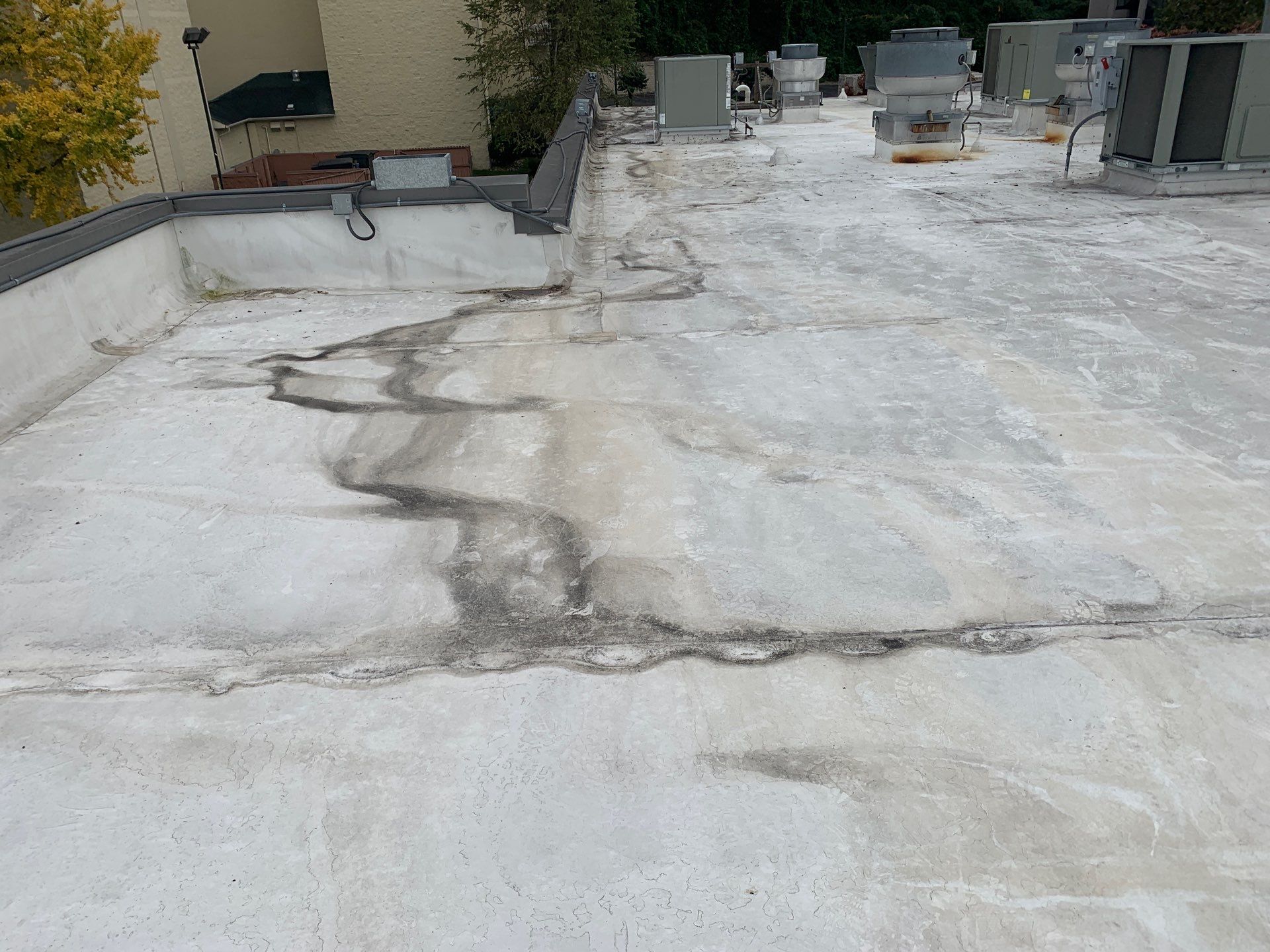
Wind damage on a flat commercial roof concentrates at the edges and corners.
Boston sits on a harbor, which means every nor'easter and every severe thunderstorm line that moves through carries wind loads a roof several miles inland wouldn't see. Uplift forces on a low-slope roof are highest at the perimeter and corners, not the field, so wind damage on a commercial building often shows up first as lifted membrane at the parapet or a section of coping that's simply gone — not as a leak in the middle of the space.
We are a roofing contractor, not a public adjuster. For a wind or storm damage claim, our role is inspecting the roof, documenting the damage with photos and measurements, and writing a scope for the repair — not filing the claim or negotiating the settlement. We meet the adjuster on the roof and explain what we found; the claim itself stays with the owner or whoever they've retained to handle it.
Boston's exposure runs from the outer harbor and Seaport straight through to inland neighborhoods, and wind behaves differently across that stretch. High-rises in the Financial District and Back Bay funnel wind between buildings in ways that can concentrate uplift on a roof that wouldn't otherwise be exposed. Lower commercial buildings near Dorchester and the South End, some converted from triple-decker-era structures with older roof assemblies, can lose loose-laid gravel ballast or older, less-secured membrane systems in the same event that a newer mechanically-attached roof rides out with minor edge damage. We document what's actually there rather than assuming the damage pattern from one type of building applies to another.
What wind damage looks like on the roof
We check for lifted or torn membrane at seams and the roof edge, displaced or missing coping and counterflashing, blown-off or shifted rooftop equipment and screens, damaged skylight and curb flashing, and any evidence of wind-driven rain intrusion at penetrations. Corner and perimeter zones get the closest look because that's where uplift pressure concentrates on almost every low-slope assembly, regardless of membrane type.
We also look for damage that isn't obvious from a quick walk — a seam that's partially opened but hasn't fully separated, or edge metal that's been worked loose without visibly falling. Those are the details that turn into a full leak on the next storm if they're not caught and documented now.
Nor'easters, coastal wind, and tropical remnants
Boston's most consistent wind threat is the nor'easter — a storm system that can sit over the region for a day or more, delivering sustained wind and wind-driven rain rather than a single gust event. Severe thunderstorm lines in summer add short, intense wind bursts. New England doesn't take direct hurricane landfalls often, but tropical remnants that track up the coast can bring nor'easter-level wind and rain days apart from any tropical designation, and the roof damage from that kind of event documents the same way. We note the storm type and date range when we write the scope, because that detail can matter to how a claim is classified.
Meeting the adjuster after a wind event
When we walk a wind claim with an adjuster, we point to the specific uplift damage, explain how the roof assembly is attached and why that affects how it failed, and answer technical questions about repair versus replacement. We stay in that lane — we don't argue the payout, we make sure the roof facts going into that conversation are accurate.
Full scope, not an inflated scope
A complete wind-damage scope includes membrane and flashing repair, edge metal and coping replacement, any code-required attachment upgrades, and matching for discontinued materials where it applies. It does not include unrelated wear dressed up as storm damage. If a section of roof shows old deterioration next to fresh wind damage, we say so and separate the two clearly.
Temporary protection first, if the roof is open
If wind has opened the membrane and the roof is actively taking on water, we can dry-in or tarp the affected area before full documentation, then record both the temporary work and the remaining damage. That protects the building and supports the claim record for reasonable steps taken to prevent further loss.
Questions We Answer Before Work Starts
What counts as wind damage on a low-slope commercial roof?
Lifted or torn membrane at the edge or seams, displaced or missing coping and edge metal, blown rooftop equipment or screens, and cracked or open flashing at parapets and penetrations, usually concentrated at the roof edge and corners.
Does insurance cover wind damage from a nor'easter?
Most commercial policies cover sudden wind damage, though specifics depend on the policy and whether the loss is treated as wind versus resulting water intrusion. We document the damage and likely cause so the owner and adjuster work from the same facts.
Can you document damage from a hurricane remnant or tropical storm?
Yes. New England rarely takes a direct hurricane landfall, but tropical remnants bring the same wind-driven rain and uplift stress as a nor'easter, and we document that damage the same way.
How soon after a wind event should the roof be inspected?
As soon as reasonably possible, especially with visible membrane lifting or tears. Wind-opened seams let water in on the next rain, so early inspection and temporary protection limit secondary damage.
What if the wind damage isn't visible from the ground?
That's typical. Uplift damage at parapets, corners, and equipment curbs usually isn't visible without getting on the roof, which is why a post-storm inspection matters even without an obvious interior leak yet.
We're your roofing contractor, not a public adjuster — we document and substantiate the roof damage so you and your adjuster work from an accurate scope.